Déménagement
Bon Avenir inc.
Déménagement
Bon Avenir inc.
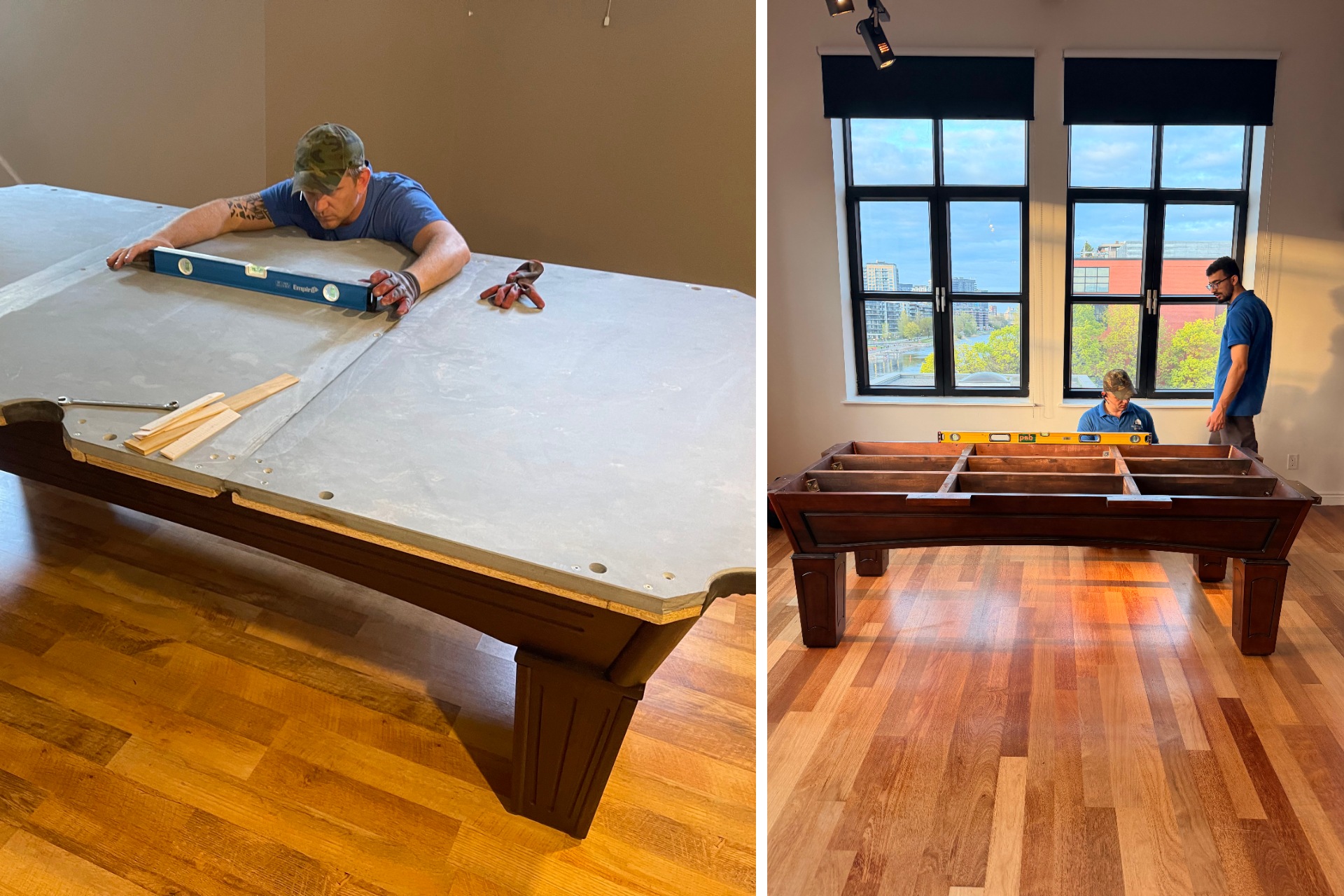
Moving a pool table is no small job. Sliding it across a room takes a few strong arms; moving it to another home is another matter entirely, because a full-size table can weigh up to 1,000 lb (about 454 kg). Its weight and its bulk are what make it so awkward to handle — and why it pays to call Déménagement Bon Avenir.
We take pool tables apart and put them back together almost every day. That is exactly what this kind of move calls for: the right equipment, and hands that have done it before.
Moving a pool table the wrong way can damage the rails, the frame, the slates and the legs — and, more seriously, injure anyone handling it without experience. Our team takes care of the disassembly, the transport and the reassembly from start to finish.


Moving a pool table starts at $450, for a job that usually takes 4 to 6 hours.
The price includes:
★ Rates may vary during the peak period (late June and early July). Every job is discussed individually.
Several things affect the price of a pool table move: stairs, the size, the weight and the type of table, and any obstacles along the way. Trust Déménagement Bon Avenir for a worry-free pool table move in Montreal, on the South Shore — including Longueuil — and on the North Shore. Contact us to find out more.
A pool table is never transported in one piece. It comes apart, travels piece by piece, and is rebuilt and levelled on site. Here is what each stage involves.
We start with the pockets and the rails, then the cloth, which is unstapled or lifted depending on how it was fitted. The slates come next, unbolted from the frame one at a time. The original hardware and shims are set aside and labelled, because they are what the reassembly depends on. The frame and the legs come apart last.
The slate is the heart of the table and by far the heaviest part: a natural stone bed that accounts for most of the total weight, with a complete table reaching up to 1,000 lb (about 454 kg). It is carried by several people, on edge rather than flat, then wrapped, blocked and strapped separately in the truck. A cracked slate cannot be repaired — it has to be replaced.
The frame, the legs and the rails are wrapped in moving blankets and strapped down so nothing rubs in transit. The cloth is rolled rather than folded, so the felt is not creased. Pockets and hardware are packed on their own.
On site, the frame goes back together in the chosen spot, then the slates are reseated, shimmed and the seams filled. Levelling comes next — the step that decides whether the ball rolls true. The cloth goes back on and the rails are realigned. Choose the final location before we arrive: once it is rebuilt, the table cannot be moved again without being taken apart.
Staircases, tight turns, narrow doors, finished basements — these are the situations we meet most often, and taking the table apart is exactly what makes them workable: the slates come down one at a time, the frame separately. Tell us in advance how many steps there are, how wide the passages are and which floors are involved at both addresses. Those details decide the size of the crew and the time needed, and they are among the factors that affect the price.
Entry-level tables often have a single-piece slate, while better tables usually have three. The difference shows on moving day: a one-piece slate is bulkier and trickier to get through a staircase or a narrow door, while three slates are easier to handle individually but need more careful shimming and seam work on reassembly. There are also synthetic-top tables, lighter and handled differently. Tell us what you have — it changes the equipment we bring.
Moved in one piece, a table strains its own frame and puts whoever is carrying it at risk. A rushed disassembly damages the rails, the cloth or the slates, and a careless reassembly leaves a table that is no longer level — something you notice on the very first game. The reasoning is the same as for a piano move: the item is worth more than the transport, and the handling is what makes the difference. Our crews do this work regularly, with the protective and lifting equipment it requires.
We work throughout Greater Montreal: Montreal, Longueuil, Brossard and Saint-Lambert on the South Shore, Laval and Terrebonne on the North Shore, along with many other municipalities. See our cities served pages to find your area. Transport within Greater Montreal is included in the rate above; if the table is part of a full move, see our prices and our residential moving service.
The service starts at $450 and includes disassembly, wrapping, transport within Greater Montreal and installation. The final amount depends on the table, the distance and the access. Rates may vary during the peak period, and every job is discussed individually.
Yes — a pool table is always moved disassembled. Taking it apart is part of the service, so there is nothing for you to prepare.
Yes. Stairs are an everyday situation, and disassembly is what makes them workable. Let us know the number of steps and the floors involved when you get in touch, as this affects the working time and the price.
The job usually takes 4 to 6 hours, from disassembly through to levelling. The time varies with the model of table, the distance and how difficult the access is.
Yes. Levelling is part of the reassembly, along with refitting the cloth and realigning the rails. It is the step that makes a table roll true.
Yes. We work in Montreal, on the South Shore — including Longueuil — and on the North Shore. The full list is on our cities served page.
Have a table to move? Write or call us with the model and both addresses, and we will tell you what the job involves.